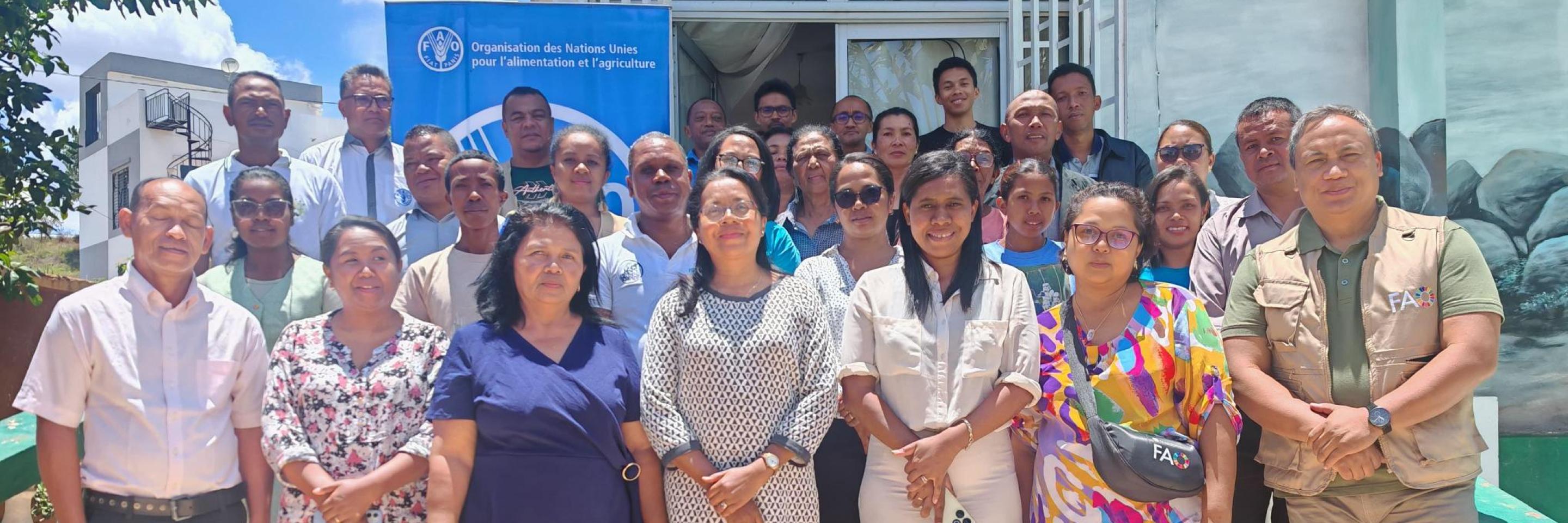
Itasy region pilots food systems transformation in Madagascar
Across Africa, countries are reorienting their agricultural policies toward more resilient, integrated food systems driven by national priorities. Embodied by the Kampala Declaration, this transition aims to align agricultural production with nutrition, optimize intervention outcomes through bundling, and focus on regions that can demonstrate the opportunities for systemic change.
Madagascar fully embraces this momentum. Its national roadmap for food system transformation has ambitious targets: strengthening local production, diversifying diets, structuring value chains, and improving governance. Yet, how can this transformation be operationalized at the regional level? Madagascar will begin with a pilot in the Itasy region, in the heart of the Highlands (Hautes Terres).
A fertile region in the centre of Madagascar, Itasy reflects the inherent tensions in Madagascar’s food system. The region offers the potential for high agriculture yields yet it also suffers from a chronic malnutrition rate of 50%, well above the national average of 39.8%. Rice yields remain stagnant at 2.2 tons per hectare, despite agroecological conditions could nearly double yields. Markets are fragmented, and post-harvest losses are estimated to reach between 11% and 15%.
A recent study conducted by the Zero Hunger Coalition and Hesat2030 confirms this diagnosis at the national level. These findings prompted a strong engagement from the National Task Force and underscored the need to focus efforts on pilot regions.
The National Task Force moves from strategy to action
The National Food Systems Task Force is responsible for orchestrating the implementation of the national roadmap - finding synergies between interventions, facilitating partnerships, and organizing the convergence of financing. Within this framework, it introduced a key mechanism, matchmaking, to create complementarities between programmes and ensure that technical and financial initiatives align with regional priorities.
This approach enabled a strategic alignment with the World Bank’s Food Systems Resilience Program (FSRP). It also ensured the continuity of financing from the European Union and the FSRP, which agreed to integrate several activities from Accelerating Food Systems Transformation through a Scalable Success Model to strengthen local value chains.
Aligning technical innovation with a regional economic vision
On the ground, the transformation underway in Itasy is already translating into tangible change. In Ampefy, the Miavotra Cooperative illustrates how a structured agroecological transition can become a lever for regional development. With training provided by IITA and Agrisud, producers have shifted their practices and made substantial gains in the production of organic rice, maize, and soybean seeds - between 30% and 50%, depending on the size of the land parcel.
With IRAT 200 maize seed and organic techniques, we have doubled our yields. This changes the way we work and opens up new perspectives. - Ms. Raharimanantsoanaivo Vololona, member of the Miavotra Cooperative
These gains highlight the engagement levels in Itasy where new solutions could be adopted immediately. However, Madagascar’s experience has repeatedly shown that lasting impact is only possible when technical innovation is embedded within a structured and coherent economic environment.
Strengthening the economic environment has begun in Itasy. The Task Force is currently supporting the development of business plans to professionalize cooperatives, improve access to credit, and organize value chains capable of absorbing surpluses. This work enables a transition from subsistence farming towards a structured rural economy capable of creating local jobs, increasing the value of products through processing, and stabilizing incomes.
We want to go further: access new markets, including export markets. This evolution shows that beyond production, the entire economic logic of farming systems is being transformed. - Ms. Baholinirina Lovatiana, President of the Miavotra Cooperative
Through the Acceleration project, another solution is advancing in Itasy: organic certification through the Participatory Guarantee System (PGS). Led by GSDM - agroecology professionals, and supported by the Supervision and Coordination Unit for Organic Agriculture (l’Unité de Supervision et de Coordination des actions sur l'Agriculture Biologique), this certification offers a mechanism for structuring local and organic value chains that are accessible to smallholder farmers.
The global demand for organic products is growing rapidly, estimated at 8% to 12% per year and mainly driven by the export market in Madagascar (vanilla, spices, cocoa, essential oils). However, the PGS is not intended to replace third-party certifications for export, but rather to strengthen local markets, local quality governance, and the anchoring of agroecological practices at the regional level.
Empowering regional governance
The transformation in Itasy is driven by technical innovation as well as by the emergence of a governance capable of coordinating action. The National Task Force supports the establishment of a Regional Task Force which will gradually become responsible for adapting interventions to local realities, targeting the most vulnerable municipalities, and monitoring progress. This regionalization of the national roadmap represents a major step forward, translating a national vision to a regional context.
As highlights the Food Systems Focal Point in Madagascar, Marina Rakotoniaina, “Food systems transformation takes shape when public policies, technical innovations, and market dynamics are anchored in territories. In Itasy, this convergence is now becoming a reality in the making.”