Prioritize, arbitrate, align: how Benin is making its food systems strategy operational

By Dossa Aguemon, Chief of Staff, Ministry of Agriculture, Livestock and Fisheries, and National Food Systems Convenor, Benin |
When countries speak about food systems transformation, the conversation often moves quickly to national pathway, advocacy, commitments, and projects. Far less attention is paid to a harder question: how are decisions are actually made across sectors, institutions, and interests?
In Benin, this question became central.
After the 2021 UN Food Systems Summit, momentum was high and important initiatives were launched. But as implementation moved forward, policies on agriculture, nutrition, climate, and value chains largely continued to advance through existing sectoral channels. Without a stronger mechanism to align these efforts, there was a real risk that another strategy would add coherence on paper without changing how decisions were made in practice.
So we made a deliberate choice. Instead of starting with a document, we started by changing the way decisions on food systems are taken.
A food system under pressure but offering high potential
Agriculture employs more than 70% of Benin’s population and contributes to over a quarter of national GDP. It anchors livelihoods and food security, particularly for smallholder farmers and informal actors. Despite encouraging results, difficulties remain such as:
Nearly 60% of households cannot afford a healthy diet.
Productivity is low and with a dependency on certain imported products. However, thanks to sustained government efforts, progress is underway with an increase in the volume of production these past few years. This progress, however, must be consolidated to permanently reduce import dependency.
Around 30% of agricultural production is lost between harvest and storage due to weak processing capacity, poor logistics, and limited market access. This tendency is starting to be reversed, primarily due to the implementation of the Glo-Djigbé industrial zone (GDIZ) which has enabled the local transformation of cotton, soybeans and cashews. Progressively extending these capacities to other areas should contribute to a significant reduction in losses and improve the value addition of agricultural products.
Climate change compounds these challenges. With a low proportion of irrigated land, production remains highly vulnerable to erratic rainfall, floods, droughts, and soil degradation. Women, youth, and rural producers bear the brunt of these shocks. For this reason, the government has initiated a large-scale hydro-agriculture development programme covering 50,000 hectares. This programme is expected to significantly improve the amount of irrigated farm land.
These realities are well known. What is less often acknowledged is that they also point to an opportunity. Because agriculture sits at the intersection between employment, diets, nutrition and rural incomes, improving how the food system functions has an outsized potential impact. Reducing post-harvest losses, strengthening local processing, improving resilience, and aligning nutrition with production are structural levers.
The problem, therefore, was not a lack of diagnosis. It was the absence of a mechanism to define priorities across sectors, manage trade-offs, and align action behind a shared national strategy. Benin’s most important innovation was a change in how the country chose to govern the dialogue on food systems.
The missing link: a space devoted to alignment and priorities
Rather than treating food systems transformation as a series of parallel sectoral discussions, Benin invested in a single space where priorities could be clarified and coherence deliberately built. This mattered because fragmentation had become a structural constraint. Agriculture, nutrition, climate, and market development were each addressed through sound initiatives, but rarely in ways that reinforced and complemented each another.
In practical terms, this meant that decisions were no longer taken within individual ministries or negotiated project by project. Issues were brought to a shared table, assessed against shared evidence on nutrition outcomes, climate exposure, and economic impact, and discussed collectively before priorities were set. No single sector could advance its agenda in isolation, and no decision rested on advocacy alone. This did not eliminate competing interests, but it made them visible, comparable, and manageable.
National dialogue as a tool for decision-making and arbitration, and not simply as a mechanism for inclusion
The national dialogue played a central role in this evolution. It was deliberately used as a tool to support decision-making, rather than as a simple platform for consultation.
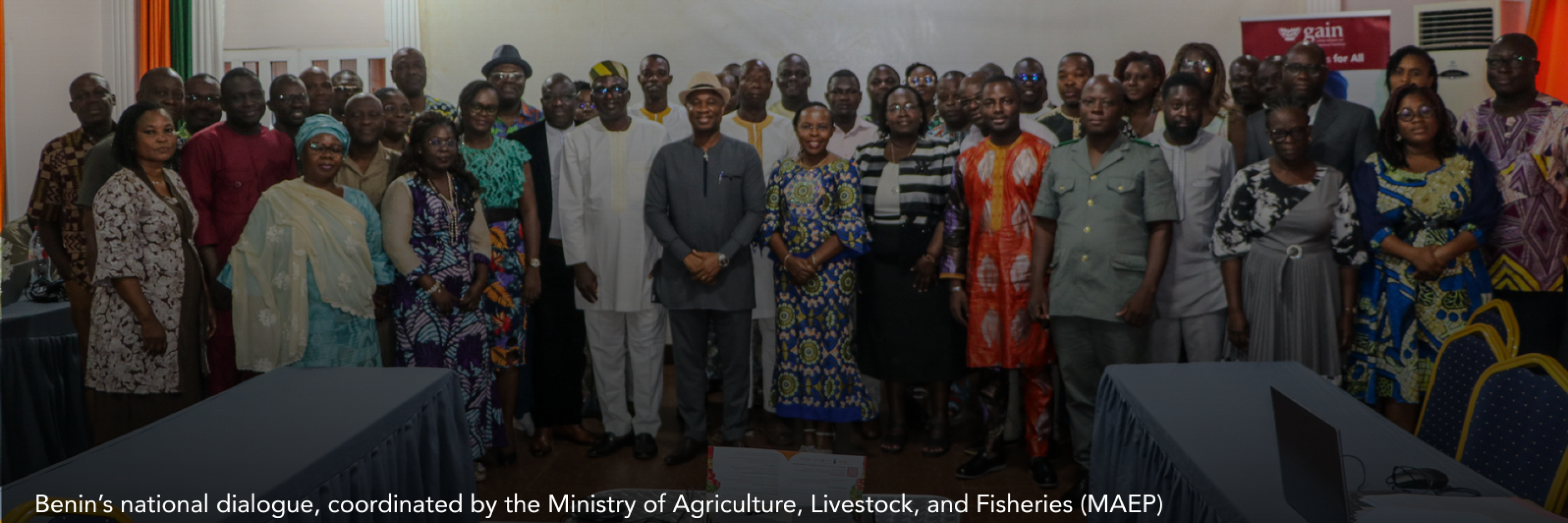
When national food systems dialogues were re-launched in Bohicon in July 2024, they were designed as working sessions. Stakeholders from government, farmers’ organisations, the private sector, civil society, research institutions, and development partners engaged around a shared evidence base and a defined set of questions:
What matters most?
What can realistically be delivered?
How should efforts be sequenced?
What level of ambition is both necessary and credible?
Because these exchanges were closely connected to decision-making structures, dialogue did not end in statements or summaries. Rather, it informed concrete strategic choices and directly shaped national priorities, targets, and implementation roll-out. Ownership was strengthened without diluting our strategic goals.
From governance to ambition
Once governance and dialogue were organised around decision-making, ambition could be addressed more clearly. The strategy sets out a simple but demanding vision:
By 2035, all Beninese should have access to healthy, culturally acceptable diets derived from local production and sustainable processing systems that are resilient to climate change and that generate wealth and employment.
To operationalise this ambition, the strategy concentrates on a limited number of interlinked priorities related to nutrition, sustainability, and equitable livelihoods. These are deliberate choices, not exhaustive lists, reflecting a decision to focus effort where impact on diets, resilience, and incomes is greatest.
Structure, accountability, and investment clarity
What will distinguish this strategy is its focus on priorities and follow-through. Each priority is linked to measurable indicators, targets for 2030, and verification sources. This transforms the strategy into a operational plan — one that can coordinate action across institutions, guide discussions on investment, and provide a basis for accountability.
For partners and investors, this shift also matters. A strategy built on priorities and measurable indicators reduces fragmentation risk, clarifies where public resources will converge, and offers a clearer basis for aligning domestic budgets, partner financing, and longer-term investment around shared outcomes.
Food systems transformation is often framed as a technical challenge. The experience in Benin suggests otherwise. The real challenge lies in the decision-making process: whether there is a space to determine priorities, to manage trade-offs, and to align action across sectors around a shared strategy.
By investing in governance, structured dialogue, and priorities, Benin has accomplished much more than a strategy document. It has built a way of working together that can sustain reform, guide investment, and adapt over time.
That is the shift that matters and where impact begins.