A National Monitoring Platform to Support Food Systems Governance
Food systems transformation is often discussed in terms of vision, public policy, and resource mobilization. While these dimensions are essential, they are not sufficient. It has become increasingly clear that assessment is needed to determine whether food systems transformation is advancing in the right direction.
Madagascar has developed an ambitious roadmap to transform its food systems. Commitments are widespread and initiatives are underway. Government ministries, local authorities, technical and financial partners, the private sector, farmer organizations, and civil society are actively contributing to this transformation. However, while implementation has progressed, a shortcoming has emerged: obtaining a consolidated view of the progress achieved and of the contributions made by each stakeholder.
Answers are needed to the following questions. Who is contributing what? What results are achieved? Which commitments are genuinely progressing? Where are the delays? What funding supports which activities? And, more importantly, how can governments effectively guide public policies when information is scattered across multiple institutions and monitoring systems?
In response to these challenges, the Ministry of Agriculture and Food Sovereignty (MiASA) has developed a new digital platform for monitoring indicators from the National Food Systems roadmap with the support of Germany through its GIZ AgSys project. The new platform is coordinated by the National Food Systems Task Force, of which the Zero Hunger Coalition is a member, alongside public and private stakeholders.
To dismiss this platform as a simple tracking system is to overlook its broader objectives. Rather, the platform establishes a common framework for consolidating data based on a shared methodology, strengthens trust and synergies between institutions, and improves the comparability of information. It also promotes collective accountability by making each stakeholder's contributions visible, while providing a common basis for guiding decisions, planning investments, and better coordinating complementary initiatives. As a result, it offers a governance approach based on shared data, transparency, accountability, and coordinated decision-making.
From commitment to results: the governance challenge
Too often, a gap remains between announced commitments and the ability to monitor implementation. Monitoring systems were fragmented, sector-specific, and disconnected from one another. Each institution produced its own data, based on its own methodology, timeframe, and reference frameworks, with little or few cross-referencing or joint analysis with other institutions.
This fragmentation not only limited coordination between stakeholders, but also rendered decision-making difficult. It could result in duplicated interventions, suboptimal allocation of resources, and a limited ability to showcase results to decision-makers as well as technical and financial partners.
Yet food systems transformation depends on an integrated approach. Agricultural and food issues are intrinsically linked to nutrition, health, the environment, infrastructure, trade, land-use planning, and financing. No single stakeholder can grasp this complexity in its entirety. It therefore became essential to establish a common framework enabling all stakeholders to collectively plan and monitor progress.
The platform developed in Madagascar responds to these requirements. It not only makes it possible to monitor the indicators defined in the national roadmap, but it also highlights the contributions of different stakeholders, clarifies institutional responsibilities, and strengthens accountability.
In other words, this platform converts data that is currently scattered into useful information that can be shared and analysed. Indicators shift from being a simple reporting requirement into a genuine governance and decision-making tool.
A demanding process requiring one year of consultations
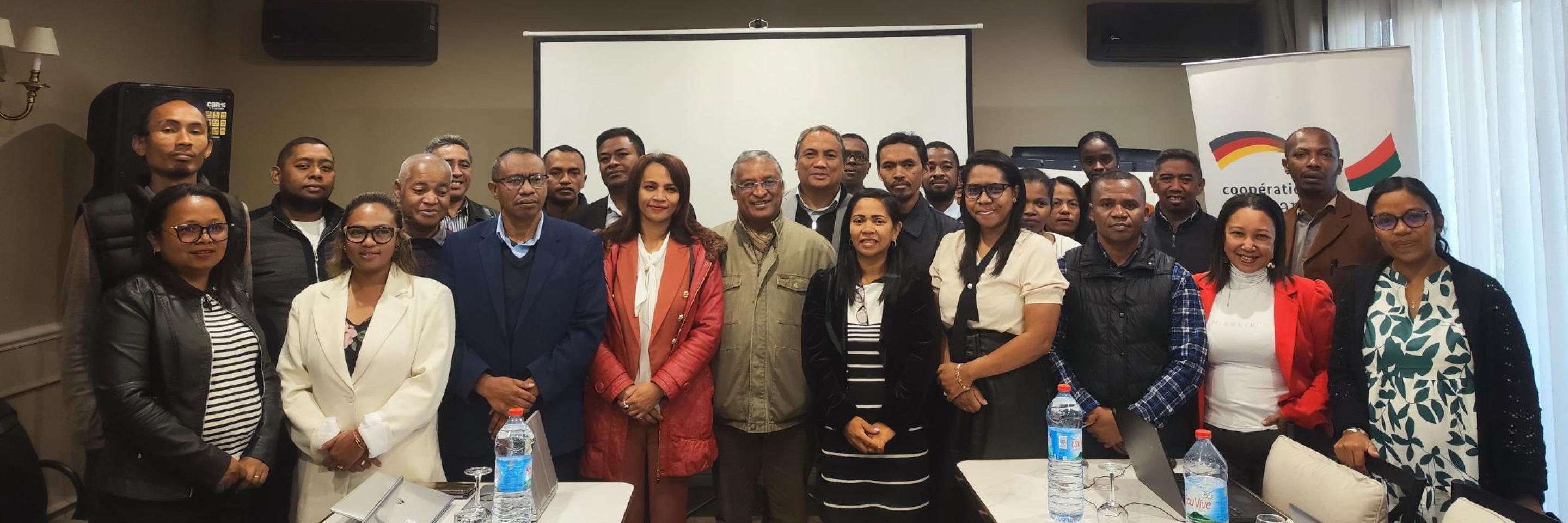
To develop this platform, an institutional process needed to build a common understanding of the information required to guide the implementation of the national food systems roadmap. Started at the end of 2024, the process took nearly one year, bringing together relevant ministries, technical and financial partners, and National Task Force members with the aim of developing a shared, credible, and sustainable governance mechanism.
Harmonizing indicators across sectors, each with its own reference frameworks, statistical methods, data-collection schedules, and information systems, proved to be one of the main challenges. Behind each indicator, multiple definitions, different data sources, and, at times, shared institutional responsibilities existed. Building a common framework was therefore more than a technical exercise – it required reaching consensus between institutions.
Bringing together the ministries responsible for agriculture, livestock, fisheries, health, the environment, industry, finance, public works, and land-use planning required extensive dialogue. These discussions made it possible to compare existing reference frameworks, clarify each organization’s responsibilities, and, where necessary, seek compromises acceptable to all stakeholders. Because of the perseverance of the members of the National Food Systems Task Force and their continuous engagement with different stakeholders, this work made significant progress.
This experience offers an important lesson: food system governance is not only built through tools or texts. It is first built through trust, dialogue, and the ability of institutions to work together.
Measuring what matters … and what can be measured
It is possible that monitoring platforms gradually become so complex that they are difficult to use. Madagascar has made a different choice: prioritizing a set of robust indicators that are reliable enough to inform decisions and simple enough to be updated over time. This choice reflects the conviction that it is better to effectively monitor a limited number of relevant indicators than multiple indicators that cannot realistically be updated.
The selection of the indicators was key. The platform draws on the implementation plan for the national roadmap, as well as the indicators of the Food Systems Countdown Initiative and of the Comprehensive Africa Agriculture Development Programme (CAADP). This ensures consistency between national priorities, regional commitments, and international monitoring frameworks.
But another choice proved equally determinant: the use of indicators that could be regularly updated with available data. This approach is pragmatic. It is also essential for ensuring the credibility of the platform.
When data become a collective responsibility
The data input mechanism is one of the most innovative aspects of the platform. The method for data collection and the frequency of data updates were determined collectively. They build on mechanisms already well-established between the relevant institutions.
The data used in the platform will be aggregated from the various stakeholders and consolidated by the Ministry of Agriculture and Food Sovereignty prior to use. An agreement protocol will be established between the overseeing ministry and the relevant institutions to ensure regular data updates and the sustainable operation of the platform. Each institution will designate a focal point responsible for the collection, validation, and transmission of data.
This approach aims to ensure a genuine culture of collective responsibility around data generation and data management. This is an essential condition for effective governance.
Towards informed decision-making
The value of a monitoring system is not only derived from its ability to generate figures. Its true value is measured by its ability to influence decisions. That is why particular attention has been given to how the platform will be used. For example, a public interface will make some information accessible to citizens, partners, and other relevant stakeholders.
The ability to connect agricultural, nutrition, health, environmental, and financial information represents a major step forward. For this reason, interoperability with other public platforms is being considered so as to cross-reference data from different sectors. This will make it possible to better understand the interactions between different areas and support decisions that are more strongly grounded in evidence.
Leveraging learning to improve action
Planning and implementation are often treated as opposites, as though one were about vision and the other about execution. Yet what distinguishes a strategy that remains on paper from one that produces results lies elsewhere; it depends on the ability of institutions to learn continuously. This means observing progress, measuring results, drawing lessons, and adjusting public action over time.
This is the capacity that Madagascar is seeking to strengthen. By making data a tool for dialogue, coordination, and decision-making, the country is creating conditions for more agile, transparent, and collective governance, capable of evolving alongside emerging food system challenges. This new digital platform is more than a simple reporting exercise.
At a time when climate, economic, and health crises are converging, and public resources and development assistance are becoming increasingly scarce, the capacity to learn and adapt is a strategic asset. The most effective public policies will not be those that have the best planned, but rather those that are best able to learn, adapt, and stay the course in times of uncertainty.
Monitoring to transform
Ultimately, this platform reminds us of an oft-forgotten truth: we can only transform sustainably what we are capable of measuring. At a time of interconnected challenges – climate, malnutrition, rural poverty, and financial constraints - having a reliable and shared national monitoring platform is a strategic necessity.
This new platform will not singlehandedly solve the challenges facing Madagascar. However, it will create the necessary conditions for better coordination, greater transparency, and stronger accountability.
Above all, it marks an important evolution in the way we approach public action: moving away from an activity-centered approach towards one that is centred on results. Monitoring is not an end to itself. Rather, monitoring gives us the means to transform.