
Who will deliver Africa’s food systems transformation?
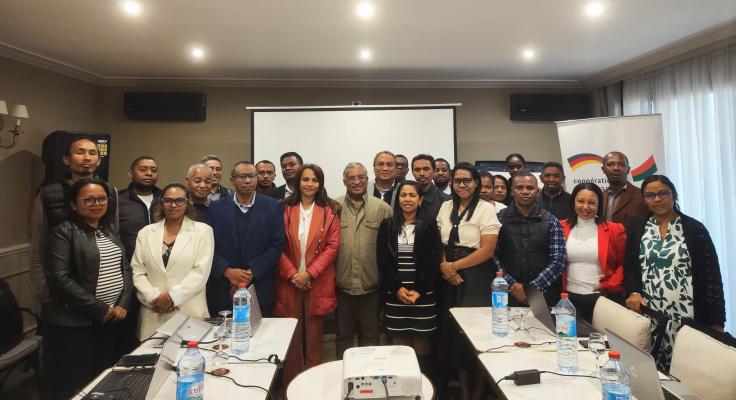
I recently participated in the Partners for Change (P4C) Network Meeting, expecting what many of us have become accustomed to: discussions about finance, markets, infrastructure, climate resilience and agricultural innovation.
Those conversations certainly took place. But they were not what stayed with me.
What stayed with me was a far more uncomfortable question. Why do we spend so much time designing transformation, yet so little time strengthening the institutions that must deliver it?
For more than two decades, Africa has steadily refined its vision for agricultural transformation. From Maputo to Malabo, and now the Kampala Declaration, each successive framework has broadened our understanding of what is required, not simply to increase production, but to build food systems that are resilient, inclusive and economically transformative.
Our vision has evolved. Yet implementation has not kept pace.
The discussions at Partners for Change made me realise that we may have been asking the wrong question. For years we have debated what Africa should do: which policies to adopt, which investments to prioritise and which innovations to scale.
Perhaps the more urgent question is whether our institutions are equipped to deliver the transformation we have already agreed upon. That changes the conversation entirely. Throughout the meeting, participants repeatedly returned to one idea: successful food systems are not built by individual projects. They are built by institutions that coordinate actors, create trust, adapt to change and provide continuity over time. Too often, progress still depends on exceptional ministers, committed development partners or donor-funded programmes. Their contribution is invaluable, but no country can sustainably transform its food systems if implementation depends primarily on individuals rather than institutions.
Projects end. Governments change. Political priorities shift…. but strong institutions endure.
This is why I believe the next phase of Africa's food systems transformation is, above all, an institutional challenge. And that brings me to Parliament.
For too long, we have viewed Parliament primarily through its constitutional functions: passing laws, approving budgets and overseeing government. Those responsibilities remain fundamental, but today's food systems demand something more.
Food systems do not fit neatly into one ministry or one parliamentary committee. They connect agriculture with trade, health, nutrition, education, finance, infrastructure and climate policy. Governing them therefore requires institutions capable of working across traditional boundaries. That is why Parliamentarians must increasingly become systems leaders.
Being a systems leader means asking different questions. Are our agricultural, nutrition and trade policies reinforcing one another, or working at cross purposes? Do our public budgets reflect our long-term ambitions for food systems transformation? Are we creating the conditions for innovation, investment and resilience, or merely responding to one crisis after another? Above all, are our decisions improving people's lives?
This is precisely why I believe the African Food Systems Parliamentary Network (AFSPaN) matters.
Strong institutions do not emerge by chance. They are built through continuous learning, access to evidence and the willingness to learn from others.
Across Africa, Parliamentarians are already demonstrating remarkable leadership. They are strengthening budget oversight, advancing reforms on food and nutrition security and finding new ways to hold governments accountable for delivering on national commitments. The Pan-African Parliament's Model Law on Food Security and Nutrition in Africa is one example of how continental institutions can support national legislative action.
If we want to accelerate implementation of the Kampala Declaration, successful parliamentary experiences must travel faster across the continent, and Parliamentarians must have easier access to the evidence that can inform better decisions.
That is the role AFSPaN seeks to play.
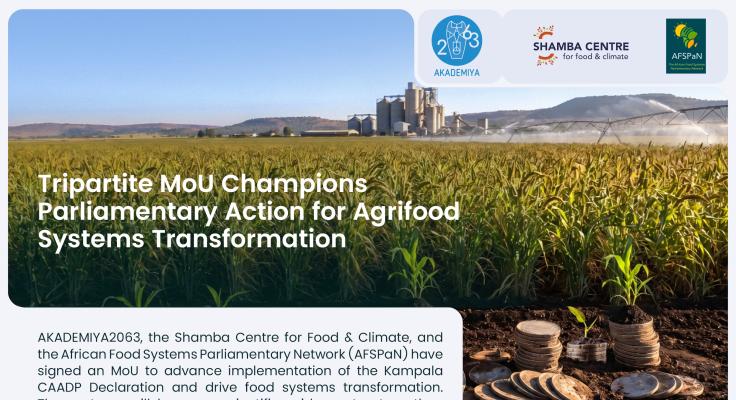
Through its partnership with AKADEMIYA2063 and the Shamba Centre, AFSPaN is establishing the African Repository for Parliamentary Action a continental knowledge platform that connects Parliamentarians with research, policy analysis and practical experiences from across Africa. The objective is to share information, and equip Parliamentarians with the evidence, tools and peer learning needed to strengthen legislation, improve budget oversight and accelerate implementation.
This same vision is reflected in AFSPaN's 10-Year Parliamentary Call to Action for Agrifood Systems Transformation, which calls for stronger parliamentary leadership, institutional learning and accountability to help turn the ambitions of the Kampala Declaration into measurable progress.
The Kampala Declaration has shown us where we want to go.The next chapter is about how we get there. That journey will be defined not by the commitments we announce, but by the institutions we strengthen.
For more information about the African Food Systems Parliamentary Network (AFSPaN), please visit the following webpage:
https://www.zerohungercoalition.org/en/supporting-parliamentarians
Watch a short clip of Hon Daniel Molokele in an interview with Kah Walla during Partners for Change 2026.